

A Deep Dive Into Torticollis in Infants:
Understanding Head Preference and Neck Tightness
Licensed Prenatal Chiropractor in McKinney, TX Explains:
When a baby consistently turns or tilts their head to one side, it is often more than a simple preference. This pattern may signal infant torticollis, a common but frequently overlooked condition in which restricted neck movement affects how comfortably a baby can move and position their head. For many infants, this pattern reflects a physical restriction in the neck and surrounding structures that limits normal movement. Left unaddressed, this restriction can influence comfort, feeding positions, head shape, and early motor development.
Torticollis is an important condition to identify early because it is frequently mechanical and structural in nature. When joints, muscles, and connective tissues are not moving freely, the nervous system and muscles cannot coordinate properly. Early intervention focused on restoring motion can help prevent secondary issues, including compensatory movement patterns and the potential need for helmet therapy.
At Legacy Family Chiropractic in McKinney, Texas, Dr. Amber Galipp-Leger provides gentle, infant-specific chiropractic and craniosacral care focused on resolving physical restrictions associated with torticollis. Families from McKinney, Allen, Frisco, Prosper, and the greater DFW area seek care when they want a conservative, hands-on approach that addresses the root mechanical limitations affecting their baby’s movement.
What Is Torticollis in Infants?
Torticollis is characterized by a persistent head tilt or rotation preference, most often caused by tightness or restriction in the muscles and joints of the neck. Parents may notice that their baby consistently looks in one direction, resists turning the head the opposite way, or prefers feeding and sleeping positions that reinforce the imbalance.
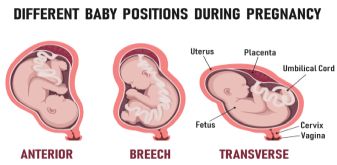
In many cases, torticollis develops due to positioning in the womb, the birth process, or early postnatal positioning. These factors can create areas of stiffness or joint restriction that limit how the neck moves, even when a baby otherwise appears healthy.
Because babies rely on comfortable neck motion to explore their environment, restrictions can quickly affect how they interact with the world around them.
Why Early Structural Care Matters
When the neck does not move freely, muscles on one side may remain shortened while the opposite side weakens or overcompensates. This imbalance can affect how the head rests against surfaces, increasing the risk of flattening or asymmetrical head shape.
Addressing the physical restriction early—before compensatory patterns become established—can reduce strain on developing muscles and joints. In many cases, restoring motion and balance may help minimize the likelihood that a child will need helmet therapy later on.
Dr. Amber’s approach focuses on improving mobility first, allowing the nervous system and muscles to function more normally as the baby grows.
How Chiropractic and Craniosacral Care Support Torticollis
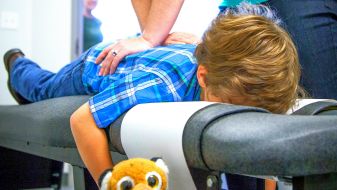
Infant chiropractic care looks very different from adult care. Dr. Amber uses gentle, precise techniques designed specifically for infants, with no forceful movements. Care focuses on the neck, spine, and pelvis to identify and release areas that are not moving as they should.
In addition to chiropractic adjustments, craniosacral therapy is often incorporated to address tension patterns in the head and surrounding tissues. This gentle approach supports balanced motion of the cranial structures and may help reduce strain contributing to head preference and asymmetry.
The goal is to restore motion, reduce restriction, and support proper nerve and muscle signaling so the baby’s body can move and adapt more comfortably.

Junior's Bedtime Lotion
For some infants with tension or discomfort around the neck and upper back, we sometimes suggest supportive, calming tools like the Junior’s Bedtime Lotion. This gentle, organic lotion is formulated to help relax muscles and soothe restless tension that can interfere with sleep or comfort. When parents use it with slow, calming touch—especially around the shoulders, chest, and belly—it may help babies relax into rest and ease sensations that can accompany gas or digestive discomfort. It’s one more gentle way to support comfort alongside our hands-on care.
Supporting the Nervous System and Muscle Coordination
Movement and nervous system function are closely linked. When joints are restricted, nerve signaling to the muscles can be altered, making it harder for the body to coordinate balanced movement.
By improving joint mobility and reducing tension, chiropractic and craniosacral care help create an environment where muscles can respond more appropriately and movement patterns can normalize. Parents often notice improved head turning, greater comfort with positioning, and easier transitions during daily activities.
Care is always conservative and individualized, based on how the baby responds.
When Occupational Therapy May Be Helpful
In some cases, torticollis is part of a broader neurological or developmental picture. When movement challenges extend beyond structural restriction—such as delays in motor milestones or difficulty coordinating movement—additional support may be appropriate.
At Legacy Family Chiropractic, Valerie Cantu, OTR, MOT, DMI (Level C) is available to provide occupational therapy focused on neurological development and motor coordination when needed. Occupational therapy is introduced only when appropriate, and always as a complement to structural care.
This collaborative model ensures that babies receive the right level of support without over-treating or escalating care unnecessarily.
Serving McKinney and the Greater DFW Area
Legacy Family Chiropractic is located in McKinney, Texas and serves families from Allen, Frisco, Prosper, and surrounding North Dallas and DFW communities. Many families seek care after noticing persistent head preference, stiffness, or asymmetry that does not resolve on its own.
Our focus is on early, conservative intervention—addressing physical restrictions clearly and calmly, while working alongside pediatric providers when appropriate.
When to Seek Care for Infant Torticollis
If your baby consistently turns or tilts their head to one side, resists movement in one direction, or shows signs of developing head asymmetry, early evaluation may be beneficial. Addressing restrictions sooner rather than later can support more comfortable movement and reduce the likelihood of secondary concerns.
Infant chiropractic and craniosacral care are commonly used alongside routine pediatric care and do not replace medical evaluation. Always consult your pediatrician regarding developmental concerns or changes in your baby’s movement.
Support Healthy Neck Movement Early
If you are concerned about head preference, neck stiffness, or torticollis in your baby, early support focused on restoring motion may help prevent more involved interventions later on.
At Legacy Family Chiropractic, Dr. Amber Galipp-Leger provides gentle chiropractic and craniosacral care designed to address physical restrictions and support healthy movement in infants.
Call (214) 880-6330 today to schedule an infant evaluation and discuss whether supportive care may be appropriate for your baby.
Medical disclaimer: This content is for educational purposes only and does not replace medical advice, diagnosis, or treatment. Always consult your pediatrician regarding infant health, feeding concerns, and developmental milestones.